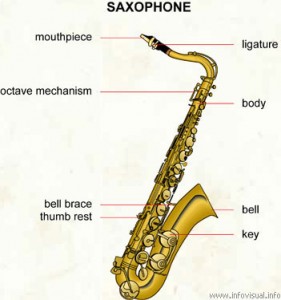
39 saxophone diagram with labels
How to Play Saxophone Notes (Part 1): How to Read the Saxophone ... The first notes we are going to learn are G, A, B, C, and D. How to Finger G, A, B, C and D on the Saxophone, Off a Finger Chart. The note G is fingered as follows: You only need to have the left first, left second and left third finger keys pushed down. The note A is fingered as follows: Saxophone Parts - Full Diagram And A Great Video Review The mouthpiece is held in place by the neck of the saxophone. The neck joins the mouthpiece and the body of the sax. When the mouthpiece is blown, the air flows through the neck to get to the body of the sax where the sound is changed to produce different notes. The saxophone neck is believed to work the same way the human neck works. BODY:
Instrument Construction - Saxophonia A labeled diagram of an Alto Saxophone. Tenor Sax Diagram. How the Saxophone is Made. Brass tubes used to create saxophones and other instruments made out of brass. Saxophone Keys. The Steps of Making a Saxophone-The body of the saxophone is the first part made

Saxophone diagram with labels
Alto Sax Fingering Chart - McGill Music Sax School Online Grab this free saxophone fingering chart, including Altissimo notes, and keep it handy on your music stand!. This is the same fingering chart that many of our Sax School students use every single day in their practice. I use it in my practice as well! Get the finger chart for this lesson - plus all of our other free resources - Free Fingering Chart inside Locker A Guide To The Different Parts Of The Saxophone Parts of the Saxophone. If you're learning how to play the saxophone it helps to have a good idea of the different parts and its basic design. Most types of saxophones are broken down into three different sections: the mouthpiece. the neck. the body. In this post we'll be looking at the anatomy of the alto and tenor saxophones which are ... Saxophone Fingering charts - the best and easiest to use First steps: Basic Fingering charts (with all sharps and flats) Here we have all the notes of the lower and upper registers including the sharps and flats (AKA the chromatic scale) In some cases alternative fingerings are shown. The first one in each case can be considered the "regular" fingering. Lower Register Lower register chromatic
Saxophone diagram with labels. Tenor Saxophone Fingering Chart Download courtesy of Art's Music Shop All About the Alto Saxophone. Alto Sax Rental fr Art's Music Shop; Why Play the Alto Saxophone? Alto Sax Care & Maintenance; Alto Sax Repair Advice; Alto Sax Fingering Chart; Alto Sax Video Resources; PDF Resources for Alto Sax; All About the Tenor Saxophone. T Sax Rental fr Art's Music Shop; Why Play the Tenor Sax? Tenor Sax Care & Maintenance Saxophone Fingering Chart PDF Download - Better Sax Near the crook of your right hand you'll notice a bar with three additional keys. These are called the side keys. In addition, you'll see an extra one or two keys, depending on your saxophone, beneath this bar. These are the side F sharp and high F sharp keys. Near your right pinky there are two more keys you can press. Saxophone keys Explained - How To Play Saxophone Here's the lowdown on how it all works… The Different Types of Saxophones and Their Keys: Sopranino is in Eb Soprano is in Bb Alto is in Eb Tenor is in Bb Baritone is in Eb Bass is in Bb Contrabass is in Eb There are others of course but I didn't include them on the list because they are very rare and not made or used anymore. Parts of the Tenor Saxophone Diagram & Diagram to Label for Beginning Band Introduce your beginner tenor saxophone students to the basic anatomy of their new instrument using the proper terminology! (If you're anything like me, you despise when "thing" is used in place of an accurate term. If they want to play it, they should know what it is called!) Includes diagram with ...
Saxophone Fingering Chart - Learn How to Play All the Notes! Having the diagrams separately but larger allows you to see everything clearly and for more notes to be included right next to the keys themselves. The diagrams for the different notes are set up like you're holding and playing the saxophone in front of you. The keys on your right will be on the right side of the diagram. Saxophone Serial Number Chart | Saxophone.org The record is much less complete after 1936. Instruments manufactured after 1936 range in serial number from ~1350-3600. The log book shows the serial numbers jumping around quite a bit for the Selmer/Adolphe Sax saxophones. Even so, its possible from this record to assemble a basic serial number chart for these instruments. The Complete Saxophone Fingering Chart All saxophones have a thumb rest right below it and it is pressed using your thumb as required. The next key marked X is for an alternate fingering which you will learn in another lesson. Next is the key marked 1. This is your index finger. Next is the key marked 2. This is for your middle finger. Next is the key marked 3. Saxophone Fingering Chart - Musika Lessons Blog Groups of keys have names. I've provided a saxophone fingering chart key that labels the key groupings. This will give you an idea of what someone is referring to when they talk about the "palm keys" or the "spatula keys" or the "side keys". In addition, certain individual keys have names they're referred to by as well.
Saxophone diagram | Etsy Check out our saxophone diagram selection for the very best in unique or custom, handmade pieces from our shops. Saxophone Major Scales: Full Range Note-by-note Fingering Charts Note #5 — A. Note #6 — B. Note #7 — C-sharp. With C-sharp, you are not holding any keys down on the saxophone. Note #8 — D. The fingering for this note is similar with the Low D but with the octave key. It is an octave above Low D. The E-flat Major Scale. The next scale is E-flat major scale. The Structure of the Saxophone:Learn the names of the parts - Musical ... Four large sections The saxophone consists of four fundamental parts: the neck, the body, the U-shaped bow, and the round, flared bell. Along the length of the instrument, there are 25 tone holes. Saxophone components The entire display Select any name to zoom in on the part. A staggering 600 parts! Saxophone Fingering Chart 2022 - Learn Saxophone Using the Saxophone Fingering Chart We chose to make this saxophone fingering chart available both as a free video tutorial and a downloadable PDF simply because it's way easier to start with seeing and hearing how each saxophone note sounds before having to focus on what's written on a piece of paper (or in a PDF-file).
Saxophone parts | Saxofoon, Reparatie
Label the Saxophone Printout - EnchantedLearning.com Word Bank: Antoine-Joseph (Adolphe) Sax (1814 - Feb. 4, 1894) was Belgian musical instrument manufacturer and musician (he played the clarinet) who invented the saxophone. Sax first exhibited his newly-invented woodwind instrument at the 1841 Brussels Exhibition, and patented it in 1846.

Saxophone Parts - Full Diagram And A Great Video Review
Saxophone Parts: Different Parts Of The Saxophone Body. The shape of the body of a saxophone is conical. It is a tube that is brass made. There are plates that connect and holds the keys, bells, keys, and other parts of the instrument. The body is a glossy or clear coating of lacquer finish. Moreover, there are nickel plated, silver plated or even gold plated body.

Orchestral Instruments & Seating - Printable Montessori Music Cards
World's best saxophone diagrams | Sax on the Web Forum Here is a simpler one with useful information from an Antigua Winds catalog: That one belongs in the "world's WORST saxophone diagram" thread. It gets at least 7 keys and parts wrong, leaves out the palm keys entirely and misspells "octave" twice. Please delete or replace with an accurate one. polemonium Registered Joined Dec 12, 2020 261 Posts
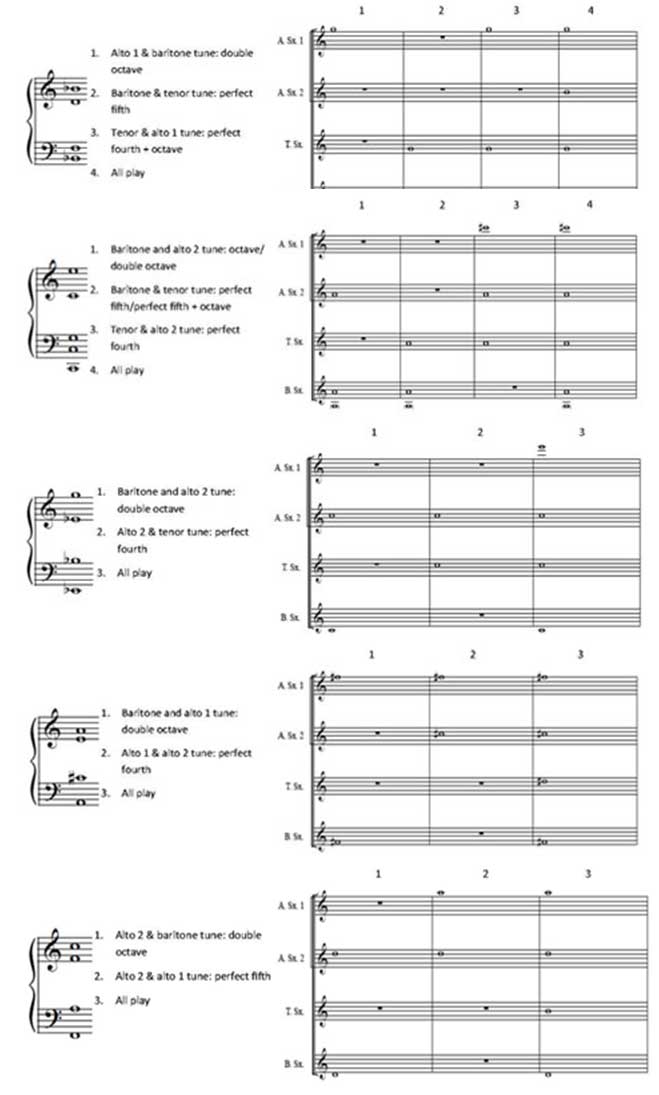
On Tuning the Saxophone Section – Band Director Media Group
Alto Saxophone Keys And Fingering Chart - Plus Video Tutorial The last key is played with the ring finger. Below these three keys are the 'cluster,' and it contains four notes. These four notes are controlled by the pinky finger. The top side keys include the D, E-flat and F key. These keys are played with the right-hand palm, index finger, and ring finger respectively.
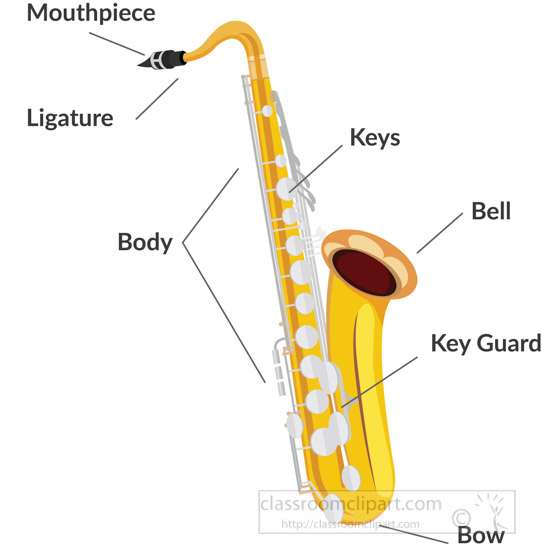
Musical Instruments Clipart - parts-of-the-saxophone-labeled-clipart-713 - Classroom Clipart
Saxophone Fingering Charts - The Woodwind Fingering Guide Below is a list of all available fingering charts for all sizes of saxophones (soprano, alto, tenor, baritone, and bass). Each fingering chart is split up by acoustic octaves, whose ranges are notated and clickable. Trills and tremolos are arranged in order by the lower, principal note. Fingering Scheme Description of keys and fingering notation

Pin by Saxgourmet Products on Saxophone Patents | Diagram, Saxophone, Sheet music
Stencil Saxophone List - SchoolOfTheRock As explained in our article Evaluating Vintage Saxophones explains, "Stencils" are vintage saxophones saxophones that were made by "name brand" companies like Buescher, Martin, and Conn, but labeled for other companies. Usually they had fewer features, less engraving, etc., but at least they were solid compared to offbrand horns.
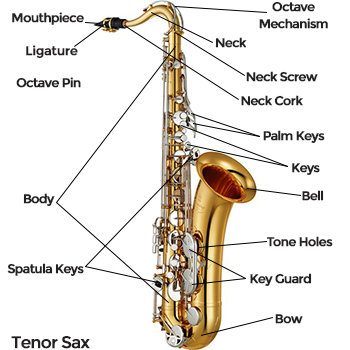
Soprano, Alto, Tenor, and Baritone Repair Pricing at Ward-Brodt Music
Saxophone Anatomy - Labelled diagram - Wordwall Saxophone Anatomy - Labelled diagram Mouthpiece, Neck cork, Ligature, Neck, Octave key, Octave pin, Neck screw, Keys, Body, Bell, Key guard, Bow. Saxophone Anatomy Share by Mrsv Music Like Edit Content Embed Log in required Theme Fonts Log in required Options Leaderboard Switch template Interactives

Picaruelo's origami: THE SAXOPHONE
Saxophone Parts and Their Functions - dummies The saxophone is a woodwind, not a brass, instrument. This fact can be hard to believe, because the saxophone is, after all, made mostly of brass. The saxophone is considered a woodwind instrument because the part that creates the actual sound, called the reed, is made out of wood, or more specifically, cane (similar to bamboo).

Saxophone (8 types, with the 4 more common ones shown on the top row) | Saxophone, Jazz ...
Eb Alto Saxophone Key Diagram - Woodwind Eb Alto Saxophone. Left Hand. Right Hand
Musical instrument instruction diagrams: get to know your instrument - Classic FM
The Definitive Sax Mouthpiece Diagram | The Bassic Sax Blog Sax Mouthpiece Diagram #3: Interior Shank View. Conn sopranino mouthpiece, on eBay.com. …this is just my blog. My "real" website is . If you're looking for sax info, you should check it out too.There's lots there! # Accessories # Diagram # Photos # Saxophone Mouthpieces. Previous Heavy Mass Saxophone Neck Screw.

Pin on Saxophone
Saxophone Fingering charts - the best and easiest to use First steps: Basic Fingering charts (with all sharps and flats) Here we have all the notes of the lower and upper registers including the sharps and flats (AKA the chromatic scale) In some cases alternative fingerings are shown. The first one in each case can be considered the "regular" fingering. Lower Register Lower register chromatic
Saxophone Classes in India - UrbanPro.com
A Guide To The Different Parts Of The Saxophone Parts of the Saxophone. If you're learning how to play the saxophone it helps to have a good idea of the different parts and its basic design. Most types of saxophones are broken down into three different sections: the mouthpiece. the neck. the body. In this post we'll be looking at the anatomy of the alto and tenor saxophones which are ...
.gif)
Miss Jacobson's Music: SCALES and FINGERING CHARTS FOR BEGINNING ORCHESTRA
Alto Sax Fingering Chart - McGill Music Sax School Online Grab this free saxophone fingering chart, including Altissimo notes, and keep it handy on your music stand!. This is the same fingering chart that many of our Sax School students use every single day in their practice. I use it in my practice as well! Get the finger chart for this lesson - plus all of our other free resources - Free Fingering Chart inside Locker
Post a Comment for "39 saxophone diagram with labels"